


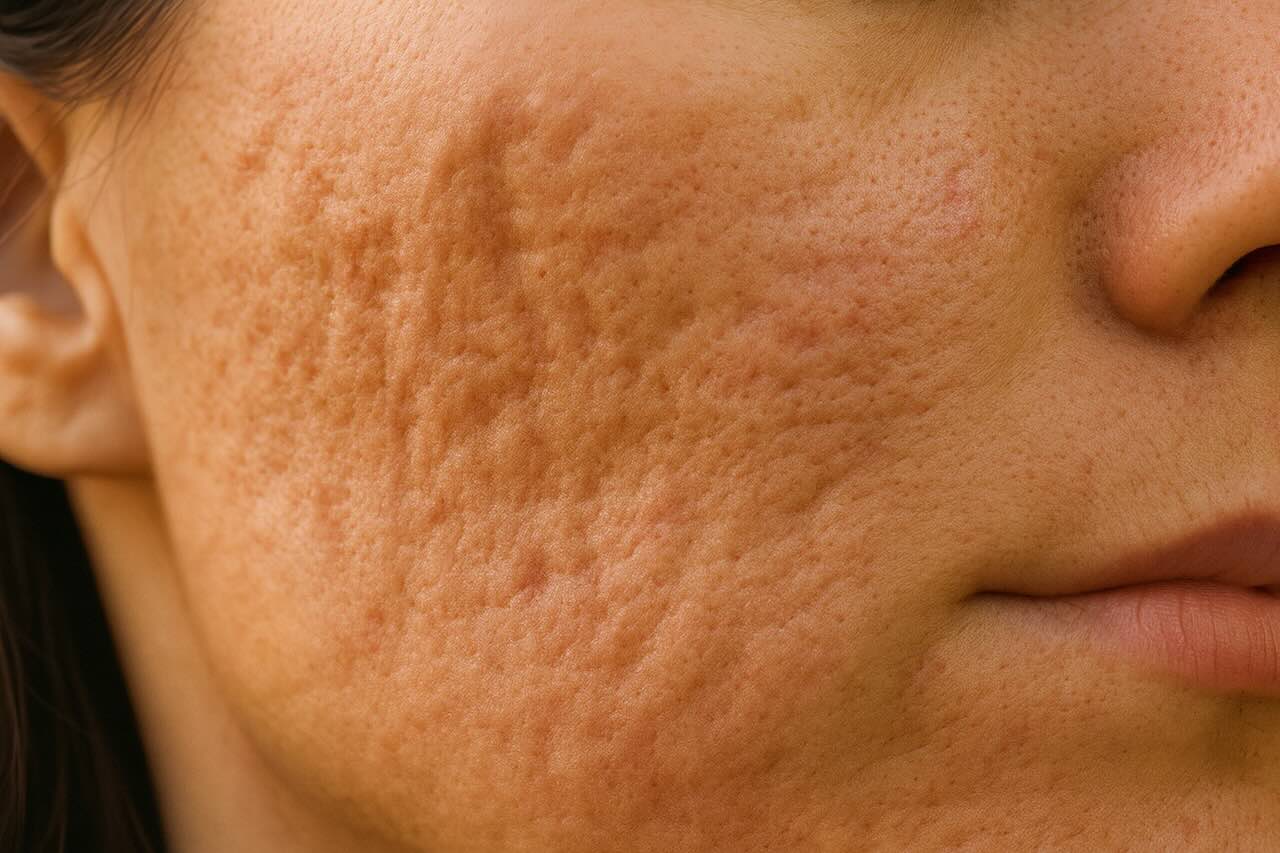
Acne scars form when inflamed breakouts damage the skin’s deeper layers, disrupting normal collagen production during healing. The main types are atrophic (depressed) scars — including ice pick, boxcar, and rolling scars — plus raised hypertrophic and keloid scars. Each type looks different.
What Are Acne Scars and How Do They Form?
Acne scars are permanent changes in skin texture that form when inflamed acne damages the deeper layers of skin during the healing process. Unlike temporary marks, true scars involve a change in the skin’s structure — either a loss of tissue (depressed scars) or an overproduction of tissue (raised scars). According to the American Academy of Dermatology, the type of scarring that develops largely depends on how the body responds to inflammation during the healing process.
The Skin’s Healing Response to Acne
When a breakout damages skin deep enough to affect collagen, the body tries to repair it. If it produces too little collagen, the skin sinks in, forming a depressed scar. If it produces too much, the skin raises, forming a hypertrophic or keloid scar.
Types of Acne Scars
There are two main categories of acne scars: atrophic (depressed) scars, which include ice pick, boxcar, and rolling scars, and raised scars, which include hypertrophic and keloid scars.
Atrophic (Depressed) Scars
Atrophic scars form when the skin doesn’t produce enough collagen during healing, leaving an indentation. They’re the most common type of acne scar and include three subtypes based on shape.
Ice Pick Scars — Ice pick scars are narrow, deep, V-shaped indentations that go straight down into the skin, often resembling a small puncture. They’re among the hardest scars to treat because of their depth.
Boxcar Scars — Boxcar scars are wider, box-shaped indentations with sharply defined edges, similar to chickenpox scars. They can be shallow or deep and typically appear on the cheeks and temples.
Rolling Scars — Rolling scars have sloped, wave-like edges that create a rolling texture across the skin. They’re caused by fibrous bands pulling the skin down from beneath the surface.
Hypertrophic Scars
Hypertrophic scars are raised, thickened areas of scar tissue that stay within the original boundary of the breakout. They form when the skin overproduces collagen while healing.
Keloid Scars
Keloid scars are raised scars that grow beyond the original wound’s boundary, sometimes becoming larger than the acne lesion that caused them. They’re more common in people with a genetic tendency toward keloid formation.
Acne Scars vs Post-Inflammatory Marks (PIH & PIE)
True acne scars involve a permanent change in skin texture, while post-inflammatory marks — hyperpigmentation (dark spots) and erythema (red marks) — are flat, temporary discoloration left behind after a breakout heals. The Mayo Clinic distinguishes these temporary marks from true structural scarring, which is a helpful line when identifying which type of mark you’re actually dealing with.
Post-Inflammatory Hyperpigmentation (Dark Spots)
Post-inflammatory hyperpigmentation (PIH) is a flat, darkened patch of skin that appears after a breakout heals, caused by excess melanin production. It’s more common and more pronounced in darker skin tones.
Post-Inflammatory Erythema (Red Marks)
Post-inflammatory erythema (PIE) is a flat, pink or red mark left behind after a breakout, caused by damaged or dilated blood vessels near the skin’s surface. It’s more visible in lighter skin tones.
How to Tell True Scars from Temporary Marks
The simplest way to tell them apart is texture: run a finger over the area with eyes closed. If the skin feels smooth but discolored, it’s PIH or PIE and will likely fade on its own. If there’s a noticeable dip or raised bump, it’s a true scar that won’t resolve on its own.
Frequently Asked Questions
What is the most common type of acne scar? Boxcar scars and rolling scars are generally the most common types of atrophic acne scars, though most people with a history of acne have a mix of different scar types.
Which acne scars are hardest to treat? Ice pick scars are generally the hardest to treat because of how deep and narrow they are.
Is post-inflammatory hyperpigmentation a permanent scar? No, post-inflammatory hyperpigmentation is not a true scar — it’s a temporary discoloration that usually fades on its own within several months to a year, though it can be slower to resolve in darker skin tones.