


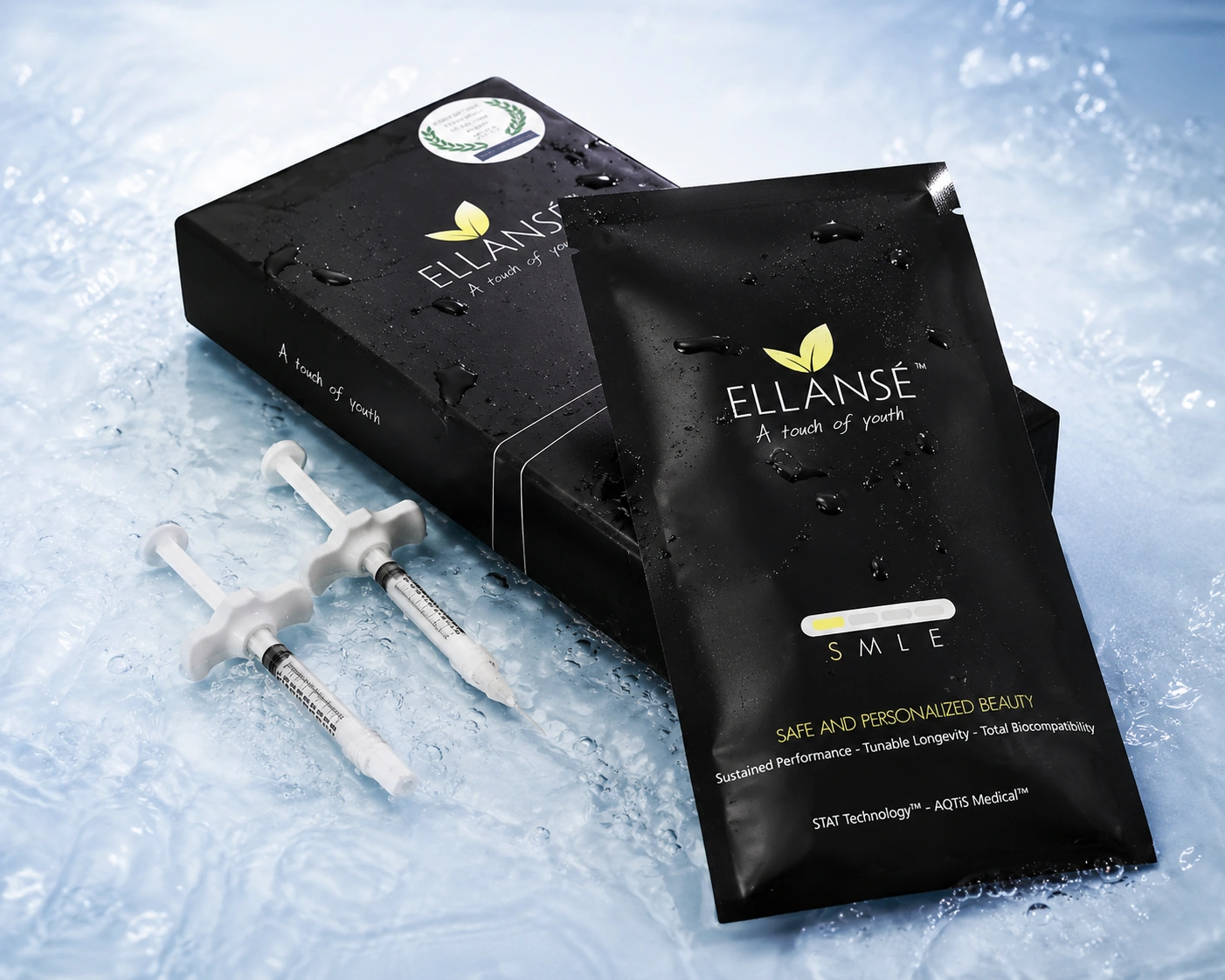
Ellanse is a dermal filler made from polycaprolactone (PCL) microspheres suspended in a collagen-stimulating gel, giving it a dual action: immediate volume on injection and long-term collagen production that continues working for months afterward. Depending on the formulation, results last from 1 to 4 years, making it one of the longest-lasting injectable fillers available.
What Is Ellanse?
Ellanse is an injectable dermal filler that combines instant volumizing effect with biodegradable PCL microspheres that stimulate the skin’s own collagen production over time. Unlike fillers that rely solely on volume, Ellanse works with the body to rebuild structural support in the skin, so results continue to improve for months after treatment before gradually and naturally breaking down.
How Ellanse Works (PCL Microspheres + Collagen Stimulation)
Ellanse is made of smooth PCL microspheres suspended in a carboxymethylcellulose (CMC) gel carrier. On injection, the gel provides immediate volume and lift. Over the following weeks and months, the gel is gradually absorbed by the body while the PCL microspheres stimulate fibroblasts to produce new collagen, gradually replacing the initial volume with the patient’s own natural collagen. The microspheres themselves are fully biodegradable and break down over time, which is why results are temporary rather than permanent.
Ellanse vs Traditional Hyaluronic Acid Fillers
Traditional hyaluronic acid (HA) fillers work primarily by adding volume through a water-binding gel that the body gradually metabolizes, typically lasting 6–18 months. Ellanse instead pairs immediate volume with active collagen stimulation, which generally means longer-lasting results (1–4 years depending on type) and a more gradual, natural-looking improvement in skin quality — though HA fillers have the advantage of being reversible with an enzyme (hyaluronidase), while Ellanse is not.
CE Mark and Safety Profile
Ellanse carries CE Mark approval for use in Europe and has been used clinically for over a decade in the UK, Europe, and Asia, with an established safety profile. It is made from biocompatible, biodegradable materials that have long been used in medical devices, including dissolvable sutures.
Types of Ellanse (S, M, L, E)
Ellanse is available in four formulations — S, M, L, and E — which differ mainly in the size and concentration of the PCL microspheres, determining how long results last: Ellanse S lasts up to 1 year, Ellanse M up to 2 years, Ellanse L up to 3 years, and Ellanse E up to 4 years.
Ellanse S — Results Lasting Up to 1 Year
Ellanse S contains smaller PCL microspheres and is typically used for finer lines, delicate areas, and patients wanting a shorter-term result before committing to a longer-lasting formulation.
Ellanse M — Results Lasting Up to 2 Years
Ellanse M is one of the most commonly used formulations, offering a balance of volumizing effect and collagen stimulation suited to moderate wrinkles, folds, and general facial contouring.
Ellanse L — Results Lasting Up to 3 Years
Ellanse L uses a higher concentration of larger microspheres, providing more structural support and longer-lasting results, making it a popular choice for cheek volumizing and jawline contouring.
Ellanse E — Results Lasting Up to 4 Years
Ellanse E is the longest-lasting formulation, designed for patients seeking maximum longevity and significant structural support, often used for larger-volume areas like the cheeks or overall facial contouring.
Which Type Is Right for You?
The right Ellanse type depends on the treatment area, the degree of volume loss or wrinkling, and how long the patient wants results to last — a qualified injector will assess facial anatomy and goals during consultation to recommend the most suitable formulation, and different types can sometimes be combined in different areas of the face.
What Does Ellanse Treat? (Areas & Uses)
Ellanse is commonly used to treat facial wrinkles and folds, restore cheek volume, define the jawline and chin, soften under-eye hollows, and rejuvenate the hands, though it is generally avoided in high-movement areas like the lips and glabella.
Facial Wrinkles and Folds
Ellanse softens nasolabial folds, marionette lines, and other moderate to deep facial wrinkles by adding volume beneath the crease and stimulating collagen to support the overlying skin.
Cheek Volume and Contouring
Because of its structural, collagen-stimulating properties, Ellanse is frequently used to restore lost cheek volume and enhance cheekbone contour, creating a lifted, more youthful mid-face appearance.
Jawline and Chin Definition
Ellanse can be strategically injected along the jawline and chin to improve definition and contour, particularly for patients seeking a sharper jawline without surgery.
Under-Eye Hollows
In experienced hands, Ellanse can be used carefully to soften mild to moderate under-eye hollowing, though this is a delicate area that requires a highly skilled injector due to the thinness of the skin.
Hands and Body Rejuvenation
Ellanse is also used off the face to restore volume to aging hands, where lost fat and thinning skin make tendons and veins more visible, helping the hands appear smoother and more youthful.
Areas Ellanse Is Not Used For (Lips, Glabella)
Ellanse is generally not recommended for the lips or the glabella (the area between the eyebrows), as these are high-movement zones prone to nodule formation with collagen-stimulating fillers, and softer, reversible HA fillers are considered a safer choice for these areas.
Benefits of Ellanse
The core benefits of Ellanse are its dual action of immediate volume plus long-term collagen stimulation, longer-lasting results than most traditional fillers, natural-looking improvement over time, and the ability to achieve significant results in a single session.
Immediate Volume with Long-Term Collagen Building
Patients see instant volumizing effect immediately after injection, while the PCL microspheres continue stimulating new collagen production for months afterward, meaning results actually improve over time rather than simply fading.
Longer-Lasting Than Traditional HA Fillers
Depending on the formulation chosen, Ellanse results last 1 to 4 years — considerably longer than most hyaluronic acid fillers, which typically require touch-ups every 6 to 18 months.
Natural-Looking, Gradual Results
Because collagen builds gradually rather than appearing all at once, results tend to look progressively natural, avoiding the “overfilled” appearance that can occur with larger volumes of instant-volume fillers.
Single-Session Treatment for Most Patients
Most patients achieve their desired result in a single treatment session, without the need for the repeated top-up appointments often required with shorter-acting fillers.
Am I a Good Candidate for Ellanse?
Good candidates for Ellanse are healthy adults with moderate to significant volume loss, wrinkles, or facial folds who want longer-lasting results than traditional fillers offer, while pregnant or breastfeeding women and those with certain skin or bleeding conditions should avoid treatment.
Ideal Candidates and Skin Concerns
Ellanse suits patients with moderate to deep facial folds, volume loss in the cheeks or hands, mild-to-moderate skin laxity, and those wanting a longer-lasting alternative to traditional hyaluronic acid fillers.
Who Should Avoid Ellanse
Ellanse is not recommended for patients with active skin infections near the treatment area, a history of keloid or hypertrophic scarring, bleeding disorders, autoimmune conditions affecting collagen production, or known allergies to any of its components.
Ellanse During Pregnancy
Ellanse, like most dermal fillers, is not recommended during pregnancy or breastfeeding, as its safety in these populations has not been established through clinical studies.
Ellanse Treatment Process — What to Expect
The Ellanse treatment process involves a consultation and facial assessment, application of local anaesthetic, a series of targeted injections, and typically takes 30–45 minutes from start to finish.
Consultation and Facial Assessment
A qualified injector assesses facial anatomy, volume loss, skin quality, and treatment goals to determine the right Ellanse formulation(s) and injection technique for the desired outcome.
Step-by-Step Injection Process
After cleansing the skin and applying anaesthetic, the injector uses a needle or cannula to place Ellanse at precise depths and locations, often massaging the area afterward to ensure even distribution and a natural contour.
Pain Management (Local Anaesthetic)
Ellanse is typically formulated with lidocaine, a local anaesthetic, to minimize discomfort during injection. Topical numbing cream may also be applied beforehand for added comfort, especially in sensitive areas.
Treatment Duration
Most Ellanse treatments take between 30 and 45 minutes, depending on the number of areas being treated and the amount of product used.
Ellanse Results Timeline
Ellanse produces an immediate volumizing effect at the time of injection, followed by progressive collagen-building improvement over the following 3–6 months, with total longevity ranging from 1 to 4 years depending on the formulation used.
Immediate Volumizing Effect
Patients typically see visible volume and contour improvement immediately after injection, though some initial swelling may temporarily exaggerate the result in the first few days.
Progressive Collagen-Building Results
As the PCL microspheres stimulate new collagen over the following months, skin quality and structural support continue to improve, with many patients noting their best results appearing around the 3–6 month mark.
How Long Results Last by Type
Longevity depends on the Ellanse formulation used: Ellanse S lasts up to 1 year, Ellanse M up to 2 years, Ellanse L up to 3 years, and Ellanse E up to 4 years, with results fading gradually and naturally as the material biodegrades.
Before & After Photos
Before-and-after photos of Ellanse treatment typically show restored cheek volume, softened folds and wrinkles, and improved facial contour, with the most complete transformation visible at the 3-to-6-month follow-up compared to immediately post-treatment.
Ellanse Cost
Ellanse typically costs between RM1,200–RM4,500 per syringe with pricing depending on the formulation (S, M, L, or E), the treatment area, the amount of product used, and the provider’s expertise and location.
Cost by Ellanse Type and Area
Longer-lasting formulations (L and E) and larger treatment areas like the cheeks generally cost more than shorter-lasting formulations (S) or smaller, more targeted areas, reflecting both the product volume used and its longevity.
Factors Affecting Pricing
Pricing is influenced by the Ellanse type selected, the number of syringes required, the complexity of the treatment area, the injector’s experience and credentials, and the clinic’s geographic location.
Cost of Touch-Ups
Because Ellanse results last significantly longer than many other fillers, touch-up costs are generally lower over time — most patients only need a maintenance session once every 1 to 4 years, depending on the formulation originally used.
Ellanse vs Other Treatments
Compared to other injectables, Ellanse offers longer-lasting results than most hyaluronic acid fillers, a more immediate volumizing effect than Sculptra, and a comparable collagen-stimulating mechanism to Radiesse with a longer potential duration.
Ellanse vs Hyaluronic Acid Fillers (Juvederm, Restylane)
HA fillers like Juvederm and Restylane are reversible and typically last 6–18 months, making them a good choice for first-time patients or delicate areas like the lips. Ellanse lasts considerably longer (1–4 years) and adds a collagen-stimulating effect, but is not reversible, so it is better suited to patients confident in their desired outcome.
Ellanse vs Sculptra
Sculptra is a purely collagen-stimulating filler (poly-L-lactic acid) with no immediate volumizing effect, requiring multiple sessions over several months to build results gradually. Ellanse provides both immediate volume and collagen stimulation, often achieving visible results in a single session.
Ellanse vs Radiesse
Radiesse, made from calcium hydroxylapatite, also offers immediate volume plus collagen stimulation and is commonly used for similar areas, but typically lasts up to about 12–18 months, while Ellanse’s longer-lasting formulations can extend results up to 3–4 years.
Side Effects and Safety
Common side effects of Ellanse include temporary swelling, bruising, and redness at injection sites, while rare risks include nodules, infection, or asymmetry — underscoring the importance of choosing a qualified, experienced injector.
Common Side Effects (Swelling, Bruising, Redness)
Mild swelling, bruising, tenderness, and redness at injection sites are common and typically resolve within a few days to a week following treatment.
Rare Risks and Complications
Less common risks include the formation of small nodules under the skin, infection, asymmetry, or a delayed inflammatory reaction — most of which are manageable when identified early by an experienced practitioner.
Importance of a Qualified Injector
Because Ellanse is not reversible like hyaluronic acid fillers, choosing a qualified, experienced injector who understands facial anatomy and proper technique is critical to minimizing risk and achieving natural, symmetrical results.
Frequently Asked Questions
How long does Ellanse last?
Ellanse results last between 1 and 4 years depending on the formulation used: Ellanse S (up to 1 year), Ellanse M (up to 2 years), Ellanse L (up to 3 years), or Ellanse E (up to 4 years).
Is Ellanse better than hyaluronic acid fillers?
Ellanse isn’t universally “better,” but it offers longer-lasting results and active collagen stimulation compared to most HA fillers. HA fillers, however, are reversible and often preferred for delicate areas like the lips, making the right choice dependent on the treatment area and patient goals.
Does Ellanse hurt?
Ellanse is formulated with a local anaesthetic to minimize discomfort, and topical numbing cream can be applied beforehand, so most patients report only mild, brief discomfort during injection.
Can Ellanse be dissolved?
Unlike hyaluronic acid fillers, Ellanse cannot be dissolved with an enzyme, since it works by stimulating the body’s own collagen rather than remaining as an inert gel. This is an important consideration when deciding between filler types.
Is Ellanse safe?
Ellanse carries CE Mark approval and has an established safety profile from over a decade of clinical use, with most side effects being mild and temporary. As with any injectable, safety depends heavily on proper patient selection and injector expertise.
