

What is the Difference Between Pico Laser vs Q-Switched Laser?
When it comes to fixing skin issues like dark spots, acne scars, and tattoo ink, lasers are the go-to choice. Two of the most popular types are the Q-Switched laser and the newer Pico laser. While they both target pigment in the skin, the major difference lies in how fast they work and the type of energy they use to break down imperfections.
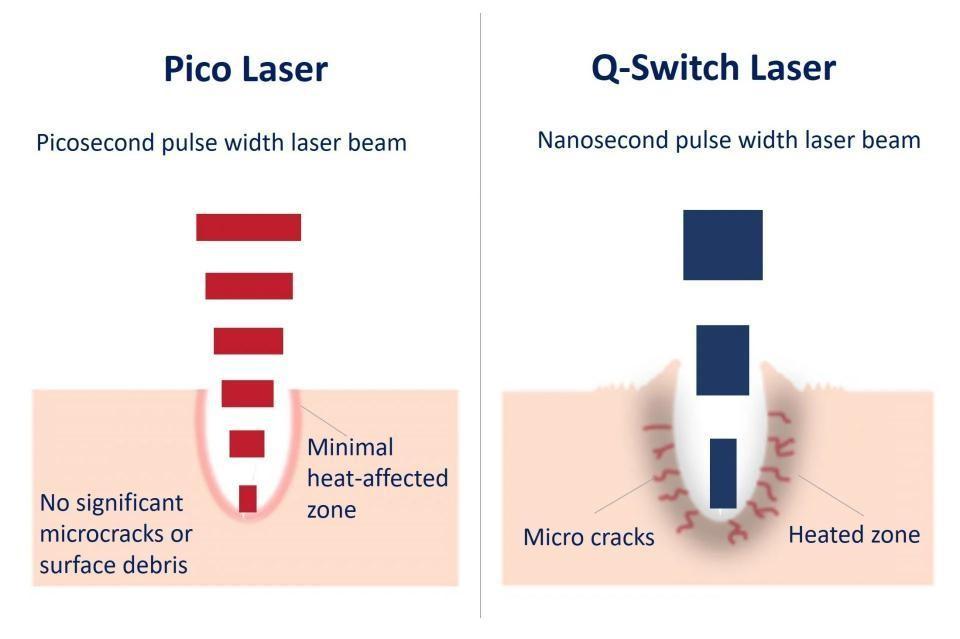
Traditional Q-Switched lasers deliver light energy in nanoseconds (billionths of a second). The newer Pico lasers deliver light energy in picoseconds (trillionths of a second). That makes a Pico laser one thousand times faster than a Q-Switched laser.
Pico Laser vs. Q-Switched Laser: How They Work
The difference in speed changes exactly how these lasers interact with your skin tissue:
Q-Switched Laser (Photothermal Effect): This laser fires pulses that heat up the target pigment (like a dark sun spot or tattoo ink) until it shatters. Because the pulse is slower, the heat stays on the skin longer, which can cause a warm or stinging sensation and leave the area red.
Pico Laser (Photoacoustic Effect): Because this laser is incredibly fast, it doesn’t give the skin time to heat up. Instead, it uses rapid pressure to create a shockwave that shatters pigment into tiny, dust-like particles. Your body’s immune system can clear away this fine dust much faster than the larger pieces left behind by a Q-Switched laser.
Comparison Table
| Feature | Q-Switched Laser | Pico Laser |
| Pulse Speed | Nanoseconds (Billionths of a second) | Picoseconds (Trillionths of a second) |
| Action Type | Photothermal: Uses heat to break down pigment | Photoacoustic: Uses ultra-fast pressure to shatter pigment |
| Particle Size | Breaks pigment into pebble-sized pieces | Shatters pigment into fine dust-sized particles |
| Downtime | 3 to 7 days of redness, swelling, or crusting | 2 to 3 hours of mild redness |
| Number of Sessions | Requires more sessions (typically 6 to 10+) | Requires fewer sessions (typically 3 to 5) |
| Skin Tone Safety | Moderate risk of dark marks on deeper skin tones | Highly safe with very low risk for all skin tones |
Why Pico Laser is Often the Better Choice
1. Faster and Cleaner Results
Because the Pico laser pulverizes pigment into a fine dust rather than larger chunks, your body clears it out much faster. This means you will usually see noticeable improvements in fewer clinic visits compared to older laser tech.
2. Significantly Less Pain and Heat
Since Pico lasers avoid building up high heat on the skin surface, the treatment is much more comfortable. Most people compare the feeling to a tiny rubber band snapping against the skin, whereas Q-Switched lasers feel much hotter.
3. Lower Risk of Side Effects
When traditional heat-based lasers are used on Asian or darker skin types, the heat can accidentally trigger cells to make more dark pigment. This side effect is called Post-Inflammatory Hyperpigmentation (PIH). Pico lasers drop this risk significantly because they rely on pressure rather than heat.
Frequently Asked Questions (FAQs)
What is the main difference between Pico and Q-Switched lasers?
The main difference is speed. Pico lasers fire light pulses in trillionths of a second, while Q-Switched lasers fire in billionths of a second. This makes the Pico laser faster, more precise, and able to shatter pigment using pressure rather than heat.
Is Pico laser more effective than Q-Switched laser?
Yes, Pico laser is generally more effective for clearing dark spots, stubborn melasma, and tattoos. Because it shatters pigment into much smaller particles, the body removes them easily, giving you better results in fewer treatment sessions.
Which laser hurts less, Pico or Q-Switched?
Pico laser hurts significantly less than a Q-Switched laser. Q-Switched lasers rely on intense heat, which can cause a burning or stinging sensation. Pico lasers use ultra-fast pressure shockwaves, eliminating the heavy heat and making the process much more comfortable.
What is the recovery downtime for both lasers?
Q-Switched lasers typically require 3 to 7 days of downtime, as the skin may experience swelling, crusting, or prolonged redness. Pico laser has almost zero downtime, with mild redness lasting only 2 to 3 hours before fading completely.
Can both lasers be safely used on dark skin tones?
While both can be used, Pico laser is much safer for darker and Asian skin tones. Q-Switched lasers carry a higher risk of causing unwanted dark marks (PIH) due to heat buildup. Pico laser avoids this issue by utilizing pressure instead of heat to protect surrounding skin cells.
