
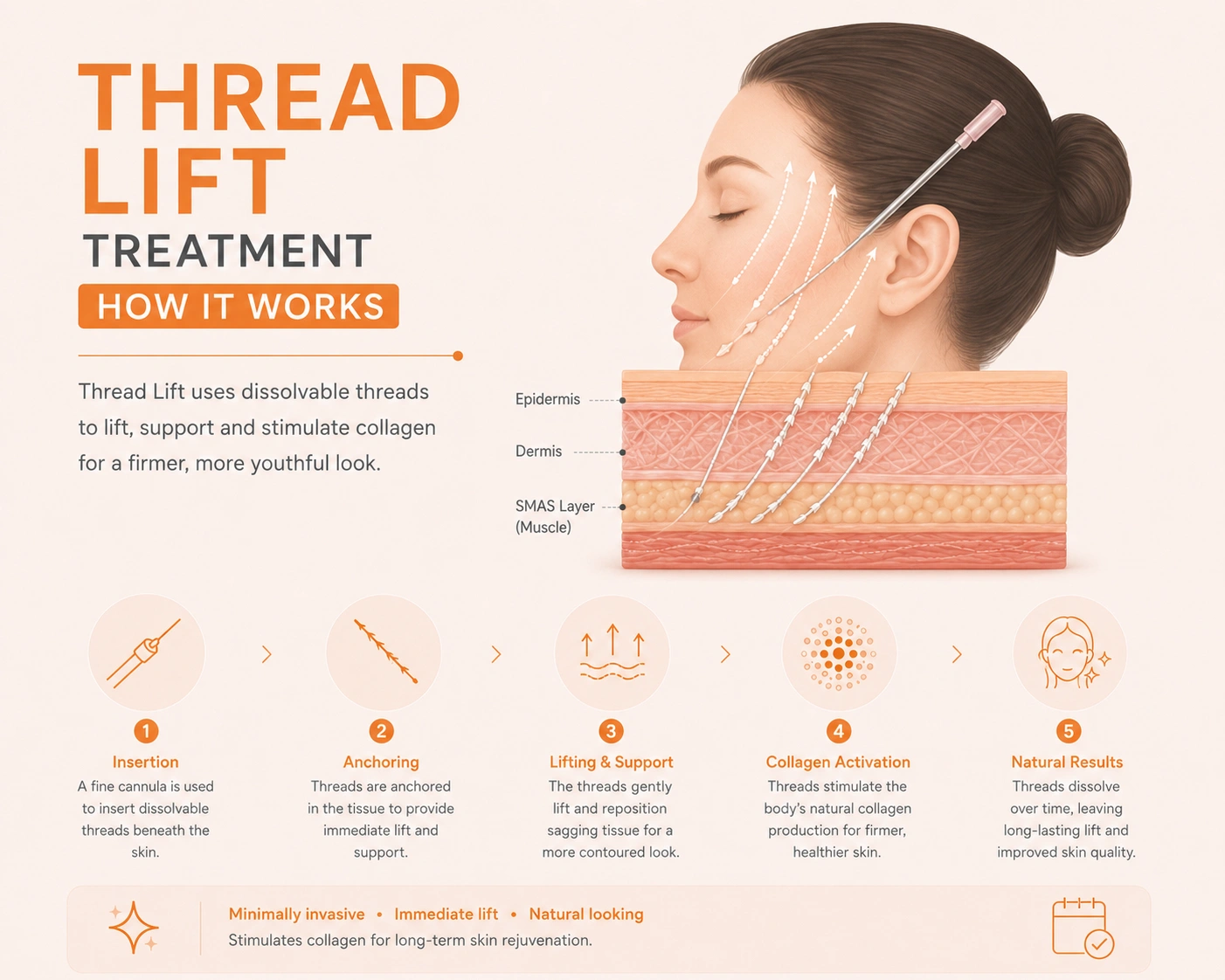
A thread lift is a minimally invasive treatment that uses dissolvable threads to lift sagging skin and boost collagen. Results appear instantly and improve over months. In Malaysia, costs range RM2,500–RM8,000. Effects last 12–24 months with little downtime.
What Is a Thread Lift?
A thread lift is a minimally invasive cosmetic procedure that lifts and tightens loose skin using medical-grade dissolvable threads. The threads are inserted under the skin with a needle or cannula to reposition sagging tissue. They also trigger collagen production, which improves skin firmness over time. Unlike a surgical facelift, there are no cuts or general anesthesia. Most threads dissolve within 6–12 months, but collagen stimulation keeps results longer.
Benefits of a Thread Lift
- Instant lift with natural results: You see an immediate repositioning of sagging skin right after the procedure.
- Collagen boost: Threads create controlled micro-injury, signaling your body to produce new collagen for firmer skin over 3–6 months.
- Minimal downtime: Most people return to work in 1–3 days. No large incisions or stitches to remove.
- Local anesthesia only: The procedure takes 30–60 minutes in-clinic. No hospital stay needed.
- Customizable: Threads can target cheeks, jawline, neck, brows, and other areas in one session.
- Reversible and adjustable: Dissolvable threads break down naturally. Results fade gradually, not suddenly.
How Does a Thread Lift Work?
The doctor marks your face to map the lift vectors. After local anesthesia, barbed or smooth threads are inserted under the skin using a fine needle or blunt cannula. Barbed threads grab the tissue and are pulled to lift it. The threads stay anchored under the skin. Over the next weeks, your body treats the threads as a wound and builds collagen around them. This “biostimulation” tightens skin and improves texture. The threads dissolve on their own, usually within 6–18 months depending on material, but the collagen remains for 12–24 months.
What Can a Thread Lift Treat?
Sagging Cheeks
Loss of midface volume causes cheeks to drop and flatten. Threads lift the malar fat pad back to a higher position, restoring youthful contour and reducing hollows.
Jowls
Jowls form when skin and fat along the jawline descend. Threads pull the lower face upward and backward, creating a sharper jawline and reducing bulges.
Jawline
A thread lift defines a weak or sagging jawline by lifting skin from the neck and lower face. It creates a more angular, V-shaped profile without filler.
Double Chin
For mild to moderate submental laxity, threads can tighten the skin under the chin. It works best when the issue is skin laxity, not large fat deposits.
Neck Laxity
Neck threads lift horizontal neck lines and crepey skin. Vertical vectoring improves “turkey neck” by repositioning loose platysma skin.
Nasolabial Folds
Deep smile lines happen when cheeks descend. Lifting the midface with threads reduces the fold indirectly, so less filler is needed.
Marionette Lines
These lines run from mouth corners to the chin. A thread lift repositions the lower face tissue upward, softening marionette lines and preventing a downturned mouth.
Eyebrow Lift
Eyebrow threads lift a drooping tail of the brow to open the eyes. It’s called a “fox eye” or “cat eye” lift. Results are subtle and last 12–18 months.
Who Is a Suitable Candidate for a Thread Lift?
You’re a good candidate if you have mild to moderate skin laxity and want lift without surgery. Ideal age is 30–55 when collagen response is still strong. Good skin thickness helps the threads anchor. You should be in good health, not pregnant, and have realistic expectations. Thread lifts don’t replace a facelift if you have severe sagging, heavy jowls, or significant excess skin. Very thin skin or active acne in the area should avoid it.
Types of Thread Lift
PDO Thread Lift
PDO (Polydioxanone) threads are the most common. They dissolve in 6–9 months. They give a moderate lift and strong collagen stimulation. PDO is affordable and versatile, used for face and neck. Results last 12–18 months.
PLLA Thread Lift
PLLA (Poly-L-Lactic Acid) threads last longer, dissolving in 12–18 months. They stimulate more collagen than PDO, so volume and firmness improve gradually. Lift is softer but longer-lasting. Results can reach 24 months. They cost more than PDO.
PCL Thread Lift
PCL (Polycaprolactone) threads are the longest-lasting, taking 24–36 months to dissolve. They provide a slow, sustained collagen boost and subtle lift. Best for patients who want results to last over 2 years. They’re the most expensive option.
Thread Lift Procedure
- Consultation: Doctor assesses your face, laxity, and goals. Photos are taken.
- Marking: Vectors are drawn on your skin while you’re upright to plan the lift.
- Anesthesia: Local anesthetic is injected at entry points. You stay awake.
- Insertion: Threads are placed using a needle or cannula along marked lines.
- Adjustment: The doctor pulls threads to lift tissue, then trims excess thread.
- Aftercare: Ice is applied. The whole session takes 30–60 minutes. You go home the same day.
Thread Lift Results
You’ll see an instant lift right after the procedure due to mechanical repositioning. At 2–4 weeks, swelling settles and the lift looks more natural. From 1–3 months, collagen production peaks and skin texture, firmness, and elasticity improve. Peak results appear around month 3. Results last 12–24 months depending on thread type, age, lifestyle, and skin quality. Smoking, sun exposure, and weight fluctuations shorten results.
Thread Lift Before and After
Before: Mild to moderate sagging, jowls, nasolabial folds, flat cheeks, or soft jawline. Skin may look tired.
After: Cheeks are lifted, jawline is sharper, jowls are reduced, and the face looks more contoured. Skin appears firmer after 3 months due to collagen. Photos should be taken in the same light and angle at baseline, 2 weeks, and 3 months to track change.
Thread Lift Cost in Malaysia
Cost depends on thread type, number of threads, doctor experience, and clinic location.
- PDO threads: RM2,500 – RM5,000 for 4–8 threads
- PLLA threads: RM4,000 – RM7,000 for 4–6 threads
- PCL threads: RM5,000 – RM8,000 for 4–6 threads
Full-face lifts cost more than targeted areas like jawline only. KL and Penang clinics charge higher than smaller towns. Prices usually include consultation, anesthesia, and follow-up. Ask if touch-up threads are included.
Thread Lift Recovery and Aftercare
Day 0–3: Swelling, bruising, and tenderness are normal. Sleep on your back with head elevated. No heavy exercise.
Day 4–7: Avoid wide mouth opening, dental work, or facial massages. Skip saunas and steam.
Week 2: Most swelling resolves. You can wear makeup.
Week 4: Resume facials, HIFU, or lasers after doctor approval.
For 2 weeks, avoid exaggerated facial expressions, sleeping on your side, and blood thinners unless prescribed. Take arnica or bromelain to reduce bruising.
Thread Lift Risks and Side Effects
Common: Bruising, swelling, soreness, dimpling, or tightness for 1–2 weeks.
Less common: Asymmetry, thread visibility or palpability, infection, puckering.
Rare: Nerve injury, thread migration, granuloma, or prolonged swelling.
Choosing an experienced doctor reduces risks. Dimpling usually settles in 2 weeks. Infections need antibiotics. Bad placement may need thread removal.
Thread Lift vs HIFU
HIFU uses ultrasound energy to heat deep skin layers and build collagen over 2–3 months. No needles. It tightens but doesn’t physically lift. Thread lift gives instant mechanical lift plus collagen. HIFU has zero downtime. Threads have 2–7 days. Many doctors combine them: HIFU first for tightening, threads later for lift.
Thread Lift vs Ultherapy
Ultherapy is also ultrasound-based, FDA-cleared for lifting. Like HIFU, it tightens with no instant lift. Results take 3–6 months. Thread lift gives immediate repositioning. Ultherapy lasts 12–18 months. Threads last 12–24 months. Ultherapy has no risk of thread-related dimpling but can be more painful.
Thread Lift vs Dermal Fillers
Fillers add volume to replace lost fat and bone. Threads lift and reposition existing tissue. Fillers treat hollow cheeks and temples. Threads treat sagging and jowls. Fillers have no downtime. Threads need a few days. Often used together: threads for lift, filler for volume.
Bottom Line
A thread lift is best if you want a noticeable but natural lift without surgery and can accept 1–3 days downtime. It won’t match a facelift for severe sagging. Pick thread type based on how long you want results and your budget. In Malaysia, choose a licensed clinic with a doctor experienced in vector planning. Maintain results with SPF, no smoking, and stable weight. For advanced laxity, combine with HIFU or fillers.
Frequently Asked Questions
How long does a thread lift last?
Results last 12–24 months. PDO lasts 12–18 months, PLLA 18–24 months, and PCL up to 2–3 years. Collagen produced around threads keeps skin firmer even after threads dissolve.
Is a thread lift painful?
The area is numbed with local anesthesia, so insertion feels like pressure or tugging, not sharp pain. Afterward, expect soreness and tenderness for 3–7 days. Painkillers manage it.
When will I see thread lift results?
You’ll see an immediate lift once threads are placed. Final results develop over 8–12 weeks as swelling goes down and collagen builds. Skin quality keeps improving up to month 6.
Is there any downtime after a thread lift?
Most people take 1–3 days off social activities due to swelling and bruising. Avoid strenuous exercise, dental visits, and facials for 2 weeks. You can work next day if remote.
Can a thread lift replace a facelift?
No. A thread lift is for mild to moderate sagging. A surgical facelift removes excess skin and tightens muscle for severe laxity. Threads can delay a facelift but not replace it.
How much does a thread lift cost in Malaysia?
Expect RM2,500–RM5,000 for PDO, RM4,000–RM7,000 for PLLA, and RM5,000–RM8,000 for PCL. Price depends on number of threads and clinic location. Full-face costs more than jawline only.
