


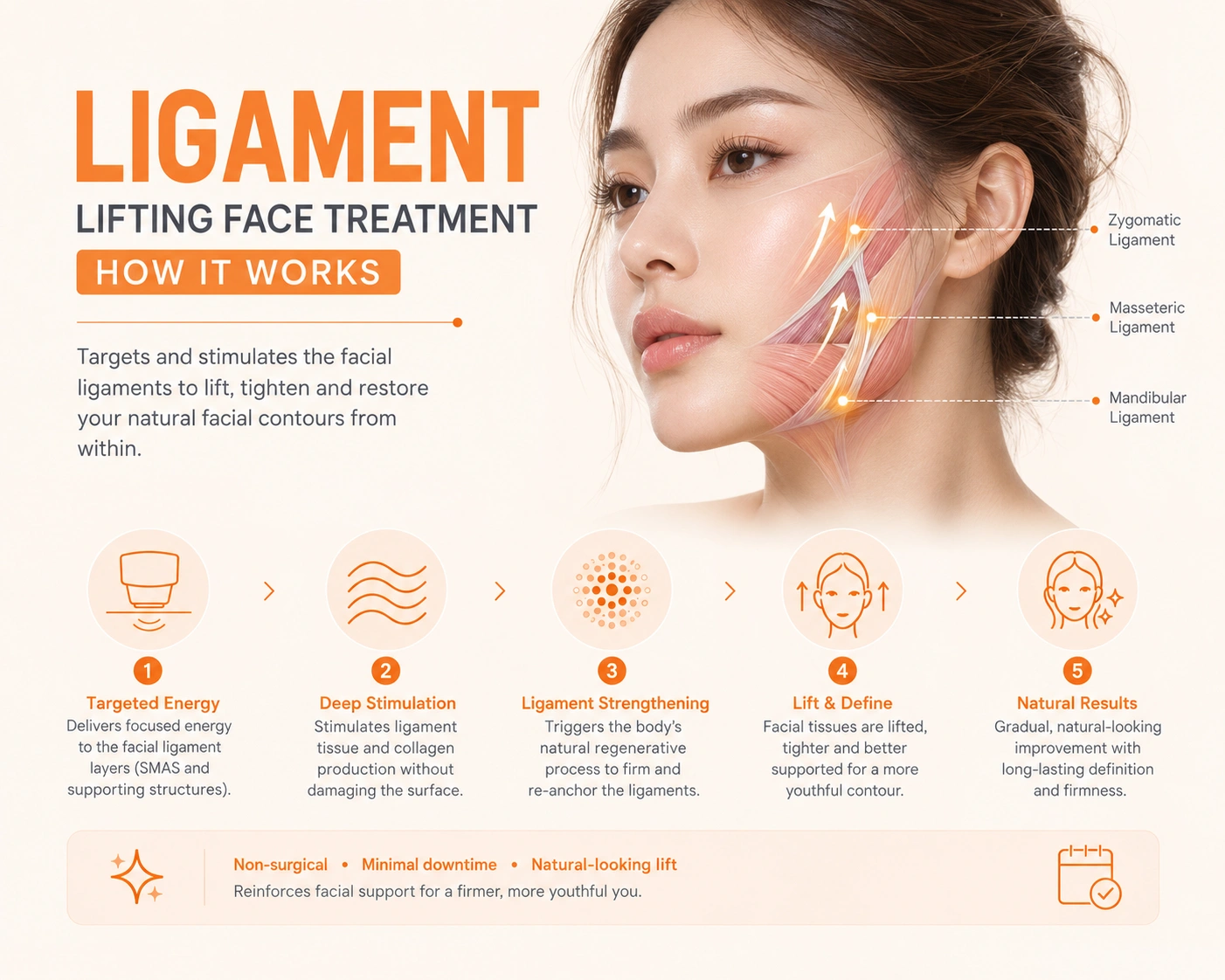
Ligament lifting is an injectable technique that treats facial sagging at its anchor points instead of simply adding volume to hollow areas. By placing a firm filler at the base of the face’s retaining ligaments, an experienced doctor can re-support tissue that has drifted downward with age — producing a lift that looks structural rather than inflated.
What Is Ligament Lifting?
Ligament lifting is a non-surgical injectable procedure in which a high-cohesivity filler is placed deep at the origin points of the facial retaining ligaments. Instead of filling wrinkles or hollows, the product reinforces the ligaments that anchor soft tissue to bone, repositioning sagging cheeks, jowls and folds upward.
The technique is sometimes called a “true lift”, “ligament lift” or “anchor lift”, depending on the training school. All of these describe the same underlying idea: treat the cause of descent, not the consequence.
Because the goal is support rather than volume, ligament lifting generally uses far less product than a conventional volumising plan — often 1 to 3 ml across the whole face. The filler acts like a scaffold, not a cushion.
Key characteristics:
- Deep, supraperiosteal or sub-SMAS placement at fixed anatomical points
- Firm, high-G prime fillers chosen for lifting capacity over softness
- Small, precise deposits at multiple anchor points
- Results that read as tightening and contour, not fullness
How Ligament Lifting Works
Facial ageing is not only volume loss. The ligaments that tether skin and fat to the facial skeleton weaken and stretch over time, allowing fat compartments to slide downward. This is what creates jowls, deepening nasolabial folds and a heavier lower face.
Ligament lifting works by restoring tension at these tether points. When filler is placed precisely at a ligament’s bony origin, it creates a firm platform beneath the descended tissue. Two effects follow:
- Mechanical support. The deposit physically elevates the soft tissue sitting above it, shortening the distance the tissue has slipped.
- Vector redistribution. Re-tensioning one anchor point pulls on the connected fascial network, so a small volume in the right place produces visible change several centimetres away.
This is why a well-placed 0.5 ml at the zygomatic ligament can soften a nasolabial fold more effectively than 2 ml injected into the fold itself. The fold is where the sagging lands; the ligament is where it starts.
Most practitioners use a firm hyaluronic acid product for this purpose, because HA offers immediate lift with the safety advantage of being dissolvable if repositioning is needed.
Ligament Lifting vs Traditional Filler
Traditional filler replaces lost volume in the area that looks deflated. Ligament lifting reinforces the anchor points that allow tissue to descend in the first place. The first approach makes the face fuller; the second makes it look lifted, usually with less product.
| Ligament Lifting | Traditional Filler | |
|---|---|---|
| Goal | Reposition and support sagging tissue | Replace lost volume |
| Injection depth | Deep — on bone or beneath the SMAS | Variable, often mid-dermal to subcutaneous |
| Target site | Ligament origin points | The visible hollow, line or fold |
| Typical volume | Lower — often 1 to 3 ml full face | Higher — can exceed 4 to 6 ml |
| Product type | Firm, high-lift capacity | Ranges from very soft to firm |
| Visual result | Contour, definition, tightening | Fullness, smoothing, plumping |
| Main risk of overuse | Under-correction if anchors are missed | Heavy, puffy or over-projected appearance |
Neither approach is universally better. Many faces need both: ligament support to address descent, then conservative volume in genuinely deflated compartments. Reviewing how conventional dermal fillers are used for volume makes the distinction clearer.
Facial Retaining Ligaments Explained
Facial retaining ligaments are fibrous structures that hold facial soft tissue in position against the skull. They are classified into two groups: true ligaments that run directly from bone to skin, and false ligaments formed by the coalescence of fascial layers. The anatomy of these ligaments and the glide planes between them underpins every lifting procedure, surgical or injectable.
True Retaining Ligaments
True retaining ligaments are osteocutaneous — they originate on bone and insert directly into the dermis, creating a fixed, non-mobile attachment.
The clinically important ones include:
- Zygomatic ligament — located on the lower border of the zygomatic arch, often referred to as McGregor’s patch. Weakening here contributes to midface descent and nasolabial deepening.
- Mandibular ligament — anchored to the anterior mandible. Laxity here allows the jowl to form and the jawline to lose definition.
- Orbicularis retaining ligament — encircles the lower orbital rim and defines the lid-cheek junction. Its laxity produces tear trough shadowing and the “cheek drop” appearance.
- Temporal ligamentous adhesion — a fixed point in the lateral brow region relevant to brow position.
These points are the primary targets in ligament lifting because they are stable, reproducible and sit directly over bone.
False Retaining Ligaments
False retaining ligaments are fasciocutaneous. They are formed where fascial layers condense rather than by direct bony attachment, so they are less rigid and more variable between individuals.
They include:
- Masseteric ligaments — a vertical series along the anterior masseter border, supporting the lower cheek
- Cervical retaining ligaments — supporting the neck and submandibular region
- Platysma-auricular ligament — a condensation near the tail of the parotid
Because false ligaments are softer and their anatomy varies, they are treated with more caution and generally with smaller deposits.
Ligament Lifting Techniques
There is no single standardised protocol. Two approaches dominate practice, and many doctors combine them within one treatment plan.
True Lift Technique
The true lift technique targets the true osteocutaneous ligaments with deep supraperiosteal deposits placed directly on bone. A needle or cannula is advanced until bony contact is confirmed, then a small bolus — often 0.1 to 0.3 ml — is deposited at each anchor.
It suits patients with moderate descent and reasonable skin quality, and typically produces the most decisive lift per millilitre. The trade-off is that it demands exact anatomical knowledge, since these points sit close to important vessels and nerves.
Subcutaneous Ligament Lifting
Subcutaneous ligament lifting works in a more superficial plane, placing product along the fascial condensations and false ligaments to create a broader supportive layer.
It produces a softer, more diffuse lift and is often preferred for thin faces, for the lower cheek and jawline, or as a refinement step after deep anchoring. Cannulas are usually favoured here to reduce bruising and vascular risk.
Many treatment plans sequence the two: deep anchors first to set the lifting vectors, then subcutaneous work to blend the transitions.
Benefits of Ligament Lifting
The main benefit of ligament lifting is a lifted, more defined facial contour achieved with minimal product and no surgery. Because the technique addresses descent rather than deflation, it avoids the heavy, over-filled look that can result from repeatedly volumising a sagging face.
Reported benefits include:
- A more natural result. Restoring structure tends to look like your own face at an earlier age rather than a fuller version of it.
- Less product needed. Lower volumes mean lower cost per session and less risk of cumulative overfilling over the years.
- Jawline and midface definition. Anchoring at the mandibular and zygomatic points sharpens the lower-face outline.
- Immediate visible change. Lift is apparent as soon as the deposits are placed, unlike collagen-based treatments that build slowly.
- Reversibility. When HA is used, hyaluronidase can dissolve the product if a result needs adjusting.
- Combines well. It layers comfortably with energy-based tightening such as Ultherapy Prime, with thread lift procedures, and with collagen biostimulators for longer-term skin quality.
Ligament lifting does not replace surgery. For advanced laxity with significant skin excess, a facelift remains the definitive option.
Ligament Lifting Procedure
A full ligament lifting session usually takes 30 to 60 minutes, including assessment, numbing and injection. Most people return to normal activity the same day, with mild swelling or bruising at the injection points settling within three to seven days.
Before the Procedure
Preparation focuses on assessment and risk reduction:
- Facial assessment. The doctor examines you upright and in motion, identifies which anchor points have weakened, and maps the lifting vectors.
- Medical history. Disclose autoimmune conditions, prior filler, previous thread or surgical lifts, and any history of cold sores or filler complications.
- Medication review. Blood-thinning medication, fish oil, and anti-inflammatories increase bruising and may be paused with your prescribing doctor’s agreement.
- Product selection. Confirm the filler brand, that it is registered with Malaysia’s Medical Device Authority, and that packaging is opened in front of you.
- Topical anaesthetic. Applied for roughly 20 to 30 minutes; most firm fillers also contain lidocaine.
During the Procedure
The injection sequence typically follows a set order:
- The face is cleansed and anchor points are marked while you are sitting upright.
- Skin is disinfected with an antiseptic solution.
- The doctor advances a needle or cannula to the target depth, confirming bony contact at true ligament sites.
- Aspiration and slow, low-pressure delivery are used to reduce vascular risk.
- Small boluses are placed at each anchor, with the face re-assessed upright between points.
- Gentle moulding is applied where appropriate, and results are reviewed with you in a mirror.
You will be asked to avoid heat, strenuous exercise, facial massage and alcohol for around 48 hours, and to sleep face-up for the first few nights.
Efficacy and Clinical Evidence
The anatomy behind ligament lifting is well established; the injectable technique itself is supported mainly by expert consensus, cadaveric studies and clinical experience rather than large randomised trials. Patients and practitioners report reliable lift, but the published evidence base is still smaller than for surgical ligament release.
What the evidence currently shows:
- Ligament anatomy is well mapped. Cadaveric studies have consistently located the zygomatic and masseteric ligaments and documented their role in facial ageing, which gives the technique a firm anatomical foundation.
- Surgical parallels are strong. Deep-plane facelift techniques that release and reposition these same ligaments have decades of documented outcomes, supporting the underlying principle.
- Injectable-specific trials are limited. Most published data on ligament-targeted filler comes from case series and technique papers rather than controlled comparisons against conventional filler placement.
- Results are operator-dependent. Outcomes correlate closely with the injector’s anatomical knowledge, which makes results harder to standardise across studies.
- Duration follows the product. HA-based results generally last 9 to 18 months depending on the filler’s cross-linking and the treated area.
Safety follows the same profile as any deep facial filler. The FDA’s guidance on dermal filler risks and approved uses remains the reference point: rare but serious vascular events are the principal concern, which is why injector training and anatomical precision matter more than product choice.
FAQ
Is ligament lifting painful?
Discomfort is mild to moderate. Topical anaesthetic is applied beforehand and most firm fillers contain lidocaine. Deep injections on bone can feel like brief pressure rather than sharp pain. Most patients rate it 3 to 5 out of 10 and tolerate the session without additional anaesthesia.
How long does ligament lifting last?
Results typically last 9 to 18 months when hyaluronic acid filler is used. Longevity depends on the product’s cross-linking, the volume placed, the treated area and individual metabolism. Deep supraperiosteal deposits generally outlast superficial ones because they experience less movement.
How much downtime is there?
Most people return to work the same day or the next. Mild swelling is common for 24 to 48 hours, and bruising at entry points can last up to a week. Avoid heat, intense exercise and facial massage for 48 hours.
Who is not suitable for ligament lifting?
It is not recommended during pregnancy or breastfeeding, with active skin infection at the injection site, in uncontrolled autoimmune disease, or with a known allergy to the filler ingredients. Patients with severe skin laxity and excess skin are usually better served by surgery.
Can ligament lifting be reversed?
Yes, when hyaluronic acid filler is used. Hyaluronidase dissolves HA product and can be used to adjust an unsatisfactory result or manage a complication. Non-HA fillers such as calcium hydroxylapatite or poly-L-lactic acid cannot be dissolved this way.
Is ligament lifting better than a thread lift?
They solve overlapping problems differently. Ligament lifting rebuilds support at fixed anchor points; a thread lift mechanically repositions tissue with barbed sutures. Ligament lifting is less invasive and reversible with HA, while threads may suit patients wanting a more pronounced repositioning of loose tissue.
How many sessions are needed?
Most patients achieve their result in a single session. A top-up at 4 to 6 weeks is sometimes advised for asymmetry or for faces with more advanced descent, followed by maintenance roughly every 12 months.
